

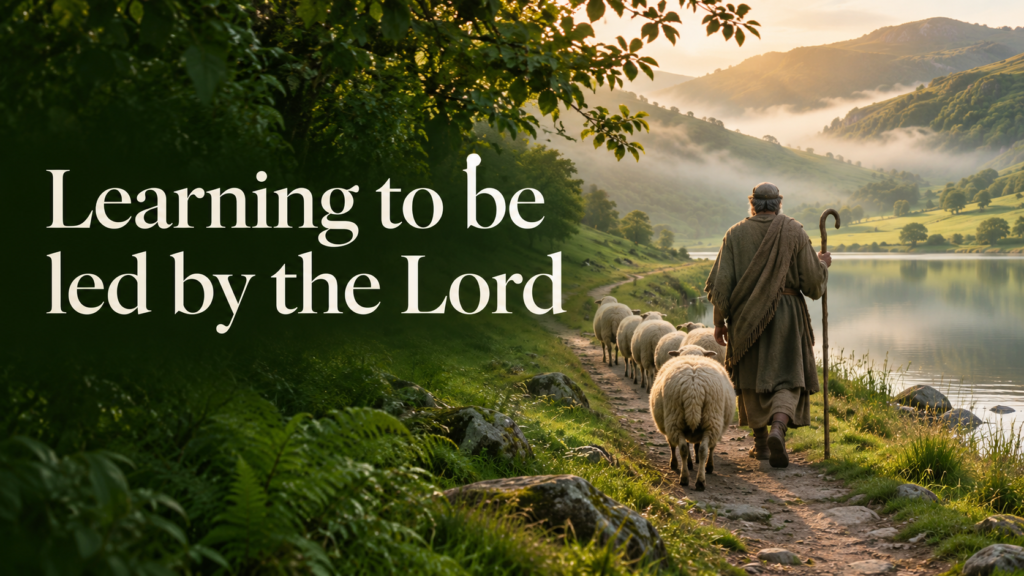
“The LORD is my shepherd; I shall not want.” — Psalm 23:1 (KJV)
When we ask God for guidance, we often want to see how things will turn out. We want to know whether to take the opportunity, how to help someone we love, or what to pray when the needs around us feel overwhelming. Psalm 23 begins somewhere more personal. Before David speaks about the paths he walks, he tells us who walks with him. The Lord is my shepherd.
What might change in our prayers if we started there?
Let the Shepherd restore you
“He maketh me to lie down in green pastures: he leadeth me beside the still waters. He restoreth my soul.” — Psalm 23:2–3 (KJV)
The first places the Shepherd leads David are places where he can rest and be restored. Many of us find it easier to keep doing something than to stop and admit how tired we are. Even in prayer, we can rush through a list of needs while carrying worries we have barely put into words.
Try beginning with a moment of quiet. Read the first few verses slowly and tell the Lord what is weighing on you. If your mind keeps returning to a particular worry, bring that worry into the conversation. You can ask for guidance and still take time to receive the Shepherd’s care.
Ask what faithfulness looks like today
David says the Lord leads him in paths of righteousness for his name’s sake. God’s guidance is tied to his character. When we face a decision, we can ask which response reflects the mercy, truth and integrity we see in Jesus.
That might mean speaking honestly in a conversation you have been avoiding, seeking wise counsel before making a commitment, or keeping a promise when it would be easier to walk away. In John 10:27, Jesus describes his sheep as people who hear his voice and follow him. We learn to recognise his voice as we spend time in Scripture and put into practice what he has already taught us.
Pray differently in the valley
“Yea, though I walk through the valley of the shadow of death, I will fear no evil: for thou art with me.” — Psalm 23:4 (KJV)
At the darkest point in the psalm, David shifts from talking about God to speaking directly to him. In the pastures it is ‘he leads me’. In the valley it is ‘thou art with me’.
Some valleys that we go through are long. We may be praying for a loved one who is sick, for a young person who has lost hope, or for communities living through conflict. Psalm 23 gives us words for the days when we can see very little ahead. We can pray, ‘Lord, you are with me here. Give me enough courage for today.’ And as we pray for others, we can ask how to make that care tangible through a call, a visit or practical help.
The psalm ends with a table prepared in the presence of enemies, a cup that overflows, and the assurance that God’s goodness and mercy will follow David all his days. Even with trouble still in view, the Shepherd has made room for him to sit and receive. We can bring our unanswered questions to the Lord and still notice the ways he is caring for us today.
Take a minute to pray
- For yourself. Ask the Lord to restore you where you feel worn down and show you one faithful step you can take today.
- For someone in a valley. Bring one person by name before God. Ask them to know his nearness and ask how you might support them this week.
- For the Church. Pray that leaders and congregations across the UK would seek the Lord together and make decisions marked by humility, courage and compassion.
A closing prayer
Lord Jesus, our Good Shepherd, quiet our hearts so we can listen to you. Restore us where we are weary and guide us where we are unsure. Stay close to those walking through dark valleys today, and show us how to walk alongside them. Lead your Church in ways that reflect your goodness and mercy. Give us the courage to follow where you lead. Amen.
Natasha Ruddock is the Communications Manager at the World Prayer Centre.